
ORIENT is born
The range and versatility of a triple, with the simplicity of a single.
Over the past 45+ years, the development of bicycle drivetrains has largely followed a strategy of simplification: reducing the number of chainrings at the front while increasing the number of cassette cogs at the rear. This approach was intended to improve the shifting experience by providing a more intuitive and predictable system for the rider. By eliminating the need to select between multiple front chainrings, the drivetrain can provide a more consistent and gradual progression of gear ratios, allowing riders to make smaller adjustments to cadence as terrain and riding conditions change. Furthermore, eliminating the front derailleur (FD), a mechanically complex and sometimes problematic component, further simplifies the system and can improve the overall riding experience.
This approach has been largely successful and has continued to evolve to the present day. However, the simplification has introduced a new challenge: increased lateral movement of the chain and the resulting limitations on chain articulation. When the rear cassette is relied upon to provide virtually the entire gear range, additional cogs are required to maintain relatively small increments between gear ratios. While this provides the rider with finer control over cadence, it also requires the chain to operate at increasingly severe lateral angles as it moves across the cassette. As a result, the very progression that has improved shifting and cadence control has also created new mechanical demands on the chain and drivetrain.
Current 1x drivetrain systems, which use a single front chainring, require the chain to operate across the full range of the rear cassette. At the extreme ends of this range—such as the smaller 10T, 11T, and 12T cogs and the larger 40T, 46T, and 52T cogs—the chain operates at significant lateral angles. This increased lateral articulation creates unnecessary friction and can reduce drivetrain efficiency.
Orient was developed to address this limitation. It is primarily a 1x drivetrain system that utilizes two optimized chainlines: one dedicated to the smaller cogs on the first half of the cassette and a second dedicated to the larger cogs on the other half. By keeping the chain more closely aligned with the selected portion of the cassette, Orient is designed to reduce excessive lateral chain movement and the associated friction.
The same concept could also be adapted to a 2x drivetrain using chainrings with different tooth counts. However, development of this configuration will depend on market and audience demand.

How it works
Orient automatically shifts the chain between its two chainrings as the rider progresses through the cassette, responding to the chain’s lateral angle. Rather than relying on a conventional front derailleur or requiring additional input from the rider, Orient uses the chain’s natural movement across the cassette as the trigger for the shift.
In an unconventional approach, we have embraced one of the biggest fears of cyclists — the “chain drop” — and transformed it into an intentional and essential element of the system. By carefully controlling this movement, Orient turns what has traditionally been considered a problem into a simple, elegant, and functional part of the shifting mechanism. Less Chain Friction. Less Chain Wear. Less Resistance. Greater Efficiency.
- No Batteries Required: Orient’s automatic shifting operates mechanically, eliminating the need for batteries, electronic controls, or charging.
- Smooth and Virtually Unnoticeable Operation: Orient shifts smoothly and seamlessly while riding—whether pedaling under load or coasting—without disrupting the rider’s experience.
- Low Maintenance: With no complex electronic or externally exposed shifting mechanisms, Orient is designed for simplicity, durability, and low maintenance, without the need for O-ring seals or oil-protected mechanisms.
- Backpedaling Friendly: Although backpedaling during a front-chainring shift is generally not recommended, Orient is designed to tolerate inadvertent backpedaling during the shifting process without the same potential interference associated with conventional external front derailleurs.
- Compatible with Existing Drivetrains: Orient is designed to work with existing combinations of rear derailleurs and cassettes currently available on the market, supporting 10-speed systems and above.
- Designed for the Next Generation of Cassettes: By addressing the challenges associated with increasing chain lateral movement, Orient opens the possibility of further increasing cassette speeds, potentially enabling 15- and 16-speed systems.

Crunching the numbers
We can identify three major periods in which bicycle drivetrains underwent significant reconfiguration.
1980s–2000s: Drivetrains predominantly combined 8- and 9-speed cassettes with triple (3x) cranksets, providing a broad gear range through multiple front chainrings.
2000s–2010s: The introduction of 10-speed cassettes coincided with the growing adoption of double (2x) cranksets. This configuration was later expanded to 11-speed cassettes, further increasing the number of available rear gears while reducing the number of front chainrings.
2010s–Present: The drivetrain underwent another major transformation with the widespread adoption of single (1x) cranksets. As the front drivetrain was simplified, rear cassettes continued to grow in both gear range and number of cogs, progressing to 12- and 13-speed systems.
This evolution has progressively shifted the responsibility for providing the bicycle’s full gear range from the front chainrings to the rear cassette. As a result, the chain is being required to operate across increasingly extreme lateral angles. The effects of this reconfiguration on chain lateral movement can be seen below.
Rings Cassette Outboard Inboard
3x 8sp 9.10mm 8.80mm
9sp 9.10mm 12.02mm
2x 10sp 14.80mm 12.85mm
11sp 14.80mm 14.80mm
12sp 14.80mm 16.35mm
1x 11sp 18.75mm 18.75mm
12sp 19.52mm 19.52mm
13sp 21.30mm 21.30mm
Below, we can see what Orient can achieve by having equivalent extreme bend numbers considering the two drivetrain configurations: the traditional 3x system (three chainrings) with an 8-speed cassette, presented above, and Orient (two chainrings with the same tooth count) paired with a 13-speed cassette, presented below.
Ring Cassette Outboard Inboard
Orient 11sp 9.00mm 3.56mm
Orient 12sp 9.00mm 5.11mm
Orient 13sp 9.00mm 8.66mm
Orient 15sp 12.65mm 12.65mm
Orient 16sp 12.65mm 12.65mm
Notice the Orient + 15-speed or 16-speed cassette configurations. Despite the increased number of rear cogs, the resulting chain-bending angles remain less aggressive than those of conventional 1x and 2x systems.

The Frame
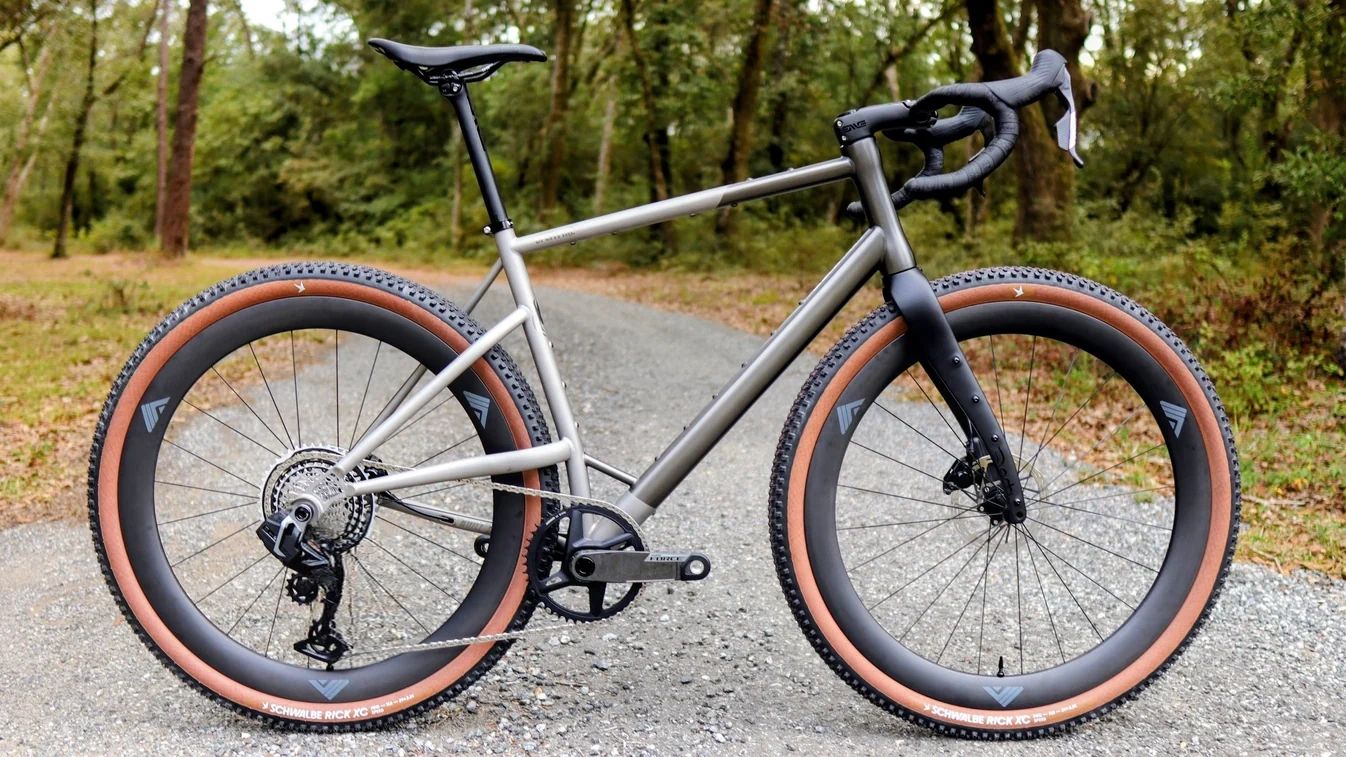
Now that we understand what Orient can do, it would be naïve to assume that the system could simply be installed on a conventional bicycle frame. It cannot. Orient requires additional clearance to accommodate the spacing between its two chainrings, so we designed a frame specifically around the system.
Enter the return of the elevated chainstay frame—a vintage concept redesigned to take full advantage of modern drivetrain requirements. The elevated chainstay configuration not only creates the necessary clearance for Orient, but also brings several additional benefits: increased tire clearance around the bottom bracket area, improved space for mud and debris to pass through, and we took a step further with additional room at the rear hub to accommodate future cassette configurations with more than 13 speeds.
Orient’s frame utilizes a 148 mm Boost rear triangle, while the entire drivetrain and rear-end geometry are offset 3 mm outboard. The frame is designed to work with a standard 142 mm rear wheel. By positioning the wheel 3 mm outboard relative to the frame, the wheel remains centered within the frame, and with the addition of the 6mm spacer on the drive site, it's effectively adding an extra 6mm of freehub space.
Tire clearance: moving the chainstay above the entire drivetrain, gives room for tires up to 2.2 inches wide using DUB Wide (Durable Unified Bottom Bracket) crankarms.
Compatible with either 29er or 32er wheels thanks to our slider dropouts.

We are partnering with Blackwater Bicycles
Available soon, you will be able to secure your deposit on the combo elevated Chainstay Frame + Orient, customized to you.
Blackwater bicycles builds titanium bicycles around the rider and the terrain. Durable materials, purposeful geometry, real tire clearance and carefully chosen standards create bikes meant to be ridden hard, kept for years and made distinctly yours.
https://www.blackwaterbicycles.com/
Future developments include the integration of our Marginal Gain rear derailleur, along with the introduction of 15- and 16-speed cassette configurations.
Orient is more than a new shifting mechanism—it enables a fundamentally different approach to drivetrain design. One of the key advantages of using two chainlines at the front, with up to 25 mm of spacing between them, is the ability to reposition the rear derailleur farther forward than in a traditional drivetrain. This creates several potential advantages, including increased chain wrap around the cassette, greater protection of the derailleur from impacts and environmental elements, and a slightly higher derailleur position relative to the ground—particularly noticeable when using a 32-inch wheel.
The Catalyst for 15- and 16-Speed Drivetrains
After analyzing the numbers presented above, the potential for additional cassette speeds becomes clear. Once the chain’s lateral movement is better controlled, there is an opportunity to take full advantage of a greater number of gears without simply increasing the mechanical compromises associated with conventional 1x systems.
The goal of Orient is not to participate in a race to continually add more cogs. It is about redefining how those gears can work together—and ultimately, redefining the cycling experience.
